Light Leaking Around Blackout Curtains? How to Seal Every Gap
This guide contains affiliate links. We may earn a commission if you buy through them, at no extra cost to you. How that works.
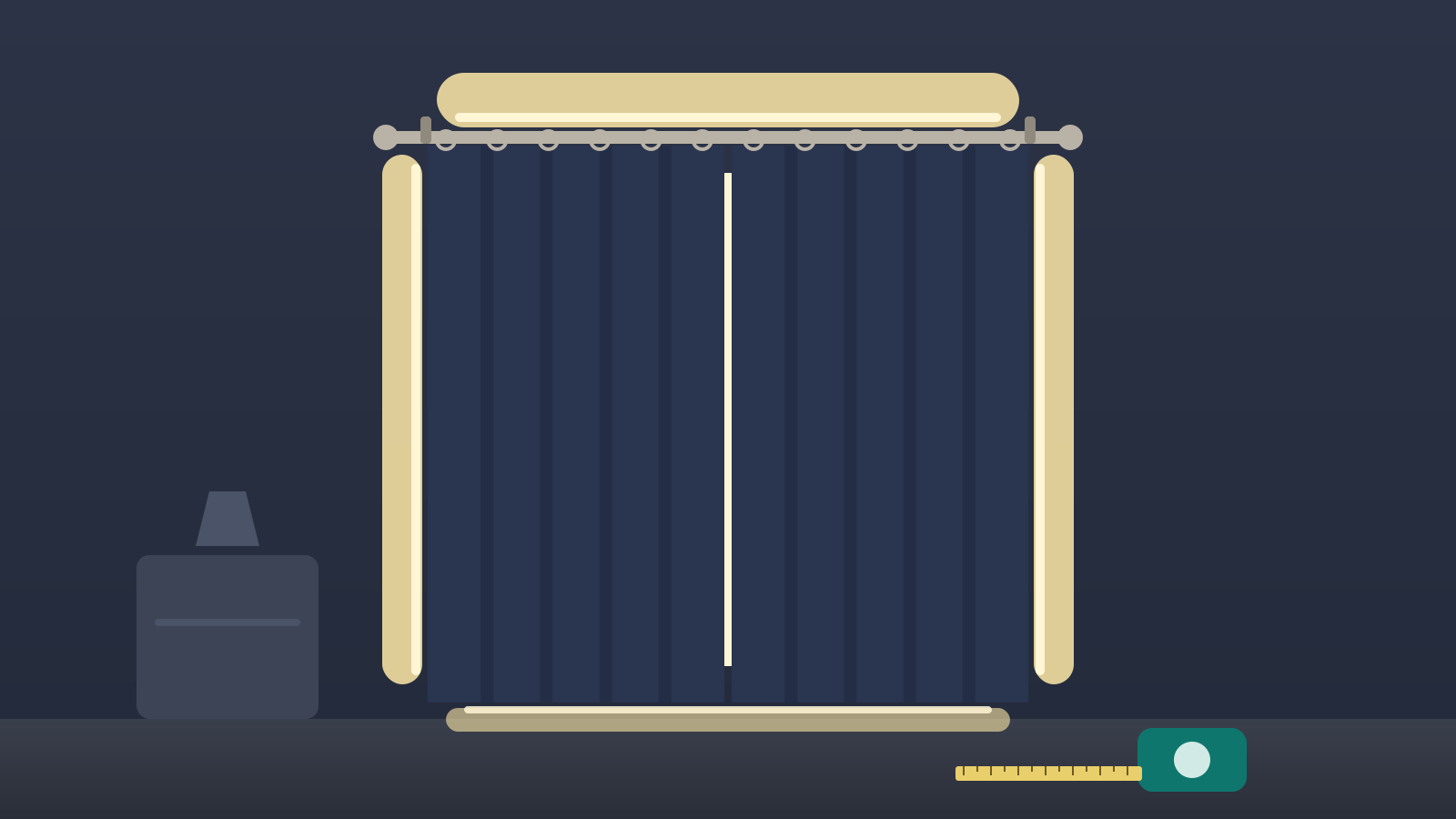
In short
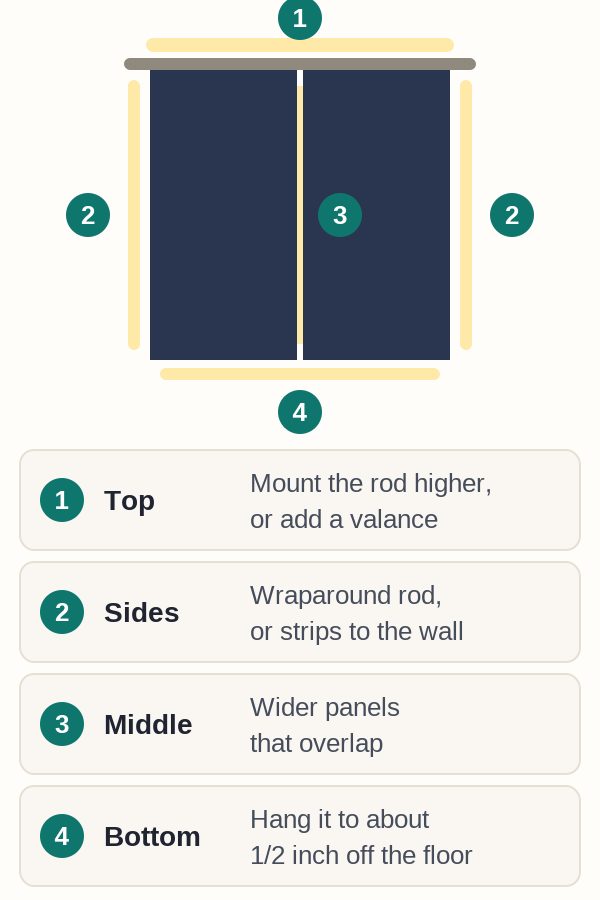
Light leaking around blackout curtains usually gets in through one or more of four gaps: over the rod, around the sides, down the middle seam and under the hem. Find which one is bright first. Then mount the rod higher and wider, close the sides with a wraparound rod or strips, overlap the panels in the middle, and hang the curtains close to the floor.
The short version
Light leaking around blackout curtains usually gets in through one or more of four gaps: over the rod, around the sides, down the middle seam and under the hem. Look at the fabric too, but start with the gaps. Find out which gap is bright, then fix that one: mount the rod higher and wider, close the sides with a wraparound rod or strips, overlap the panels in the middle, and hang the curtains close to the floor.
Most of these fixes cost little, and several need no drill. The rest of this guide walks through each gap, with the measurements curtain and rod makers themselves give.
Find the leak first
Don’t buy anything yet. Five minutes tells you which gap to fix.
- Pick the right moment. Early morning, when sunrise wakes you, or at night if a streetlight is the problem.
- Close the curtains the way you do at bedtime, turn off every light in the room and wait a few minutes for your eyes to adjust.
- Stand back and look at the edges. A sharp, bright line along an edge is a gap: light going around the fabric.
- Then look at the fabric itself. A soft glow across the panel, or tiny bright dots, means light coming through it. That’s a fabric problem, and no rod will fix it.
- Note every bright line: top, left, right, middle, bottom. Most windows have more than one.
If it’s mostly lines, read on. If it’s glow or dots, skip to light through the fabric. And if what keeps you up is a lamp, a phone or a hallway light inside the room, curtains can’t help at all: see sleep mask vs blackout curtains.
Where the light gets in, and the fix for each gap
| Why it leaks | Fix without drilling | Fix with drilling | |
|---|---|---|---|
| Top | Light bounces over the rod | A blanket or board laid over the rod | Mount the rod higher; add a cornice or valance |
| Sides | A straight rod holds the fabric off the wall | Hook-and-loop or magnetic strips to the wall | A wider rod, or a wraparound rod |
| Middle | Two panels just meet, then drift apart | Clips or magnets at the seam | Wider panels; a traverse rod with overlap arms |
| Bottom | The hem stops short of the floor or sill | A longer curtain, or a draft stopper at the sill | Lower the rod a little, if the top allows it |
| Through the fabric | Thin spots, pinholes, or “room darkening” fabric | A blackout liner, or a stick-on shade behind | A blackout shade behind the curtain |
The top: light coming over the rod
Light that hits the ceiling and wall above the window bounces down over the rod. Two things shrink it: height and a cover.
Mount the rod higher. Kirsch recommends at least 4 inches above the window (Kirsch). Umbra suggests about 4 inches, or halfway between the frame and the ceiling (Umbra), and Bali says most people go 4 to 6 inches above (Bali). Those are general guides. For full blackout, Lutron’s design note for its motorized drapery systems goes further: ideally more than 12 inches above the window, close to the ceiling, because the higher the track, the more light it blocks (Lutron).
Cover the top. Where the rod can’t go that high, Lutron’s note says to add a cornice, pocket or valance, which it says eliminates the light leaking above the drapery. Its pocket is closed on five sides with only the bottom open (Lutron). At home, that’s a wooden box or a board over the rod. Without drilling, anything laid across the brackets that closes the space between the top of the rod and the wall does the same job.
The sides: light coming around the edges
A standard bracket holds the rod a few inches off the wall. Light pours through that space and around the edge of the fabric.
Go wider. The rod and panels should reach well past the window so the edges cover the frame. Kirsch recommends at least 4 inches on each side of the window or molding (Kirsch), and Bali says at least 4 inches past the glass (Bali). IKEA’s guide says at least 15 cm, about 6 inches (IKEA). The Shade Store says panels typically extend about 6 to 12 inches past the frame (The Shade Store).
Close the side gap. A wraparound rod curves back to the wall at both ends, so the curtain wraps around and sits flush. Umbra says this design keeps curtains flush against the wall “to help stop light leaking in at the sides” (Umbra).
No drill? Hook-and-loop tape or magnetic strips stuck to the wall can hold the curtain’s edge flat against it. Hunter Douglas suggests L-shaped strips along the frame for shades with side gaps (Hunter Douglas). Check what your lease and your wall paint allow before sticking anything on.
The middle: light down the seam
Two panels that only meet in the middle part a little overnight, and a bright line shows down the center.
Make them overlap. Lutron calls panel overlap “a critical design consideration” where two panels meet, because of the direct light that leaks through that junction (Lutron). Two things help:
- Wider panels. The Shade Store multiplies the width you want to cover by 1.5 to 2 for curtain fabric (The Shade Store). Panels cut to exactly the window’s width stretch flat and leave a seam.
- Overlap arms. On a traverse rod (the kind you open with a wand or cord), the center carriers can overlap the two panels. Lutron’s note recommends extended overlap carriers, or two separate tracks where more overlap is needed.
Without new hardware, a clip or magnet holding the two edges together at the seam keeps them from drifting. See the safety note on magnets below if you have small children.
The bottom: light under the hem
Curtains that stop short of the floor or sill leave a strip of light along the bottom.
For full blackout, Lutron’s note says to keep the bottom of the drapery as close to the floor as possible, 0 to 1/8 inch, or 1/2 to 1 inch when full blackout isn’t needed so the fabric doesn’t drag (Lutron). Kirsch and Bali both measure floor-length curtains to about 1/2 inch off the floor (Kirsch, Bali).
Don’t overshoot. Lutron’s note warns against letting fabric pool on the floor, because it can stop the panels from overlapping properly. And if there’s a heater or radiator under the window, see the safety note below before you lengthen anything.
Light through the fabric
If you saw a glow or bright dots rather than lines, the fabric is letting light through.
- Check the label. Many brands sell “room darkening” and “blackout” as different lines. Room darkening fabric isn’t meant to block everything.
- “Up to 99%” isn’t 100%. Redi Shade, for example, says its blackout shades block up to 99% of exterior light (Redi Shade). On a bright morning, the last 1% can still show.
- Look for pinholes, especially along seams and where grommets are punched. Holding the panel up to a window in daylight shows them.
- Add a layer. A blackout liner behind the curtain, or a shade at the glass, stops what gets through. CDC’s training for shift-working nurses suggests “room-darkening shades and/or heavy, lined draperies” for a dark bedroom, and notes that blinds can let in too much light (NIOSH).
Shades inside the window frame leak at the sides by design
If you have a roller shade mounted inside the frame, the bright lines at its edges are built in. A shade needs room to roll without rubbing the frame. Hunter Douglas says light gaps are common to shades mounted inside the frame and are needed so they work smoothly (Hunter Douglas). Bali gives numbers for its roller shades mounted inside the frame: about 9/16 inch per side on cordless models and 11/16 inch on continuous-loop models (Bali).
Three ways around it:
- Mount it outside the frame, so it covers the opening and overlaps the wall. Bali recommends an outside mount for the best light control.
- Add side channels: tracks along each side that the shade runs inside. Lutron’s blackout design uses 2.5-inch side channels lined with black wool pile (Lutron).
- Hang curtains over it. Bali also suggests adding a drapery or curtain. The shade blocks the middle, and the curtain covers the shade’s edges.
Measure before you buy
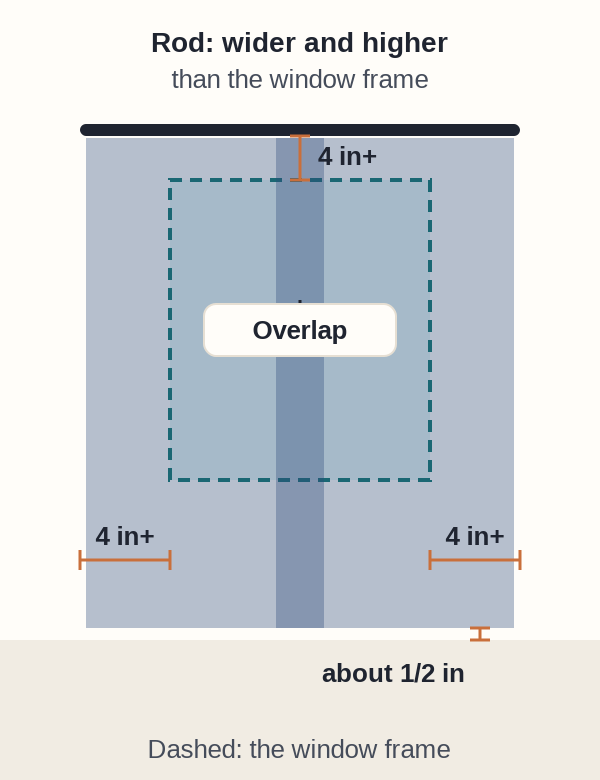
If you’re replacing the rod or the curtains, measure once with the gaps in mind:
- Width: the window frame plus at least 4 inches on each side. That’s the rod’s length, before any wraparound returns.
- Height: the rod at least 4 inches above the frame, or higher if your ceiling allows.
- Length: from the rod to the floor, minus about 1/2 inch. Lutron’s note goes closer to the floor for full blackout.
- Panel width: 1.5 to 2 times the rod’s length in total, so the panels overlap in the middle and still reach the ends.
Safety first: cords, magnets and heaters
Some common fixes bring their own risks, especially with small children in the house.
- Cords. If you add a shade or blind, choose a cordless one. CPSC says about nine children under 5 die each year on average from strangling in window covering cords, and calls cordless window coverings “the safest option.” It also advises moving cribs, beds and furniture away from windows and window covering cords, preferably to another wall (CPSC).
- Magnets. Small, strong magnets are dangerous if swallowed: CPSC warns they can attract each other inside the body and become lodged in the digestive system, and it estimates about 2,400 magnet ingestions were treated in emergency departments each year from 2017 to 2021 (CPSC). In a child’s room, hook-and-loop tape or a hardware fix is the safer choice than loose stick-on magnets.
- Heaters. The U.S. Fire Administration says to keep anything that can burn at least 3 feet from heat sources, radiators and space heaters included (USFA). Longer curtains shouldn’t end up draped over a heater under the window.
Does a little leaking light matter for sleep?
Public-health guidance is simple: NHLBI tells adults to keep the bedroom “quiet, cool, and dark,” adds that a dim night light is fine if needed, and suggests light-blocking curtains for daytime sleep (NHLBI). Light and dark have the biggest influence on the body’s daily rhythms (NIGMS).
The research on light at night is still early. In a 2023 study of 552 adults aged 63 to 84, those whose wrist sensors recorded any light during the darkest five hours of the night were more likely to have obesity, diabetes or high blood pressure than those with none (Kim et al., Sleep). The authors are clear about the limits: it shows a link at one point in time, not cause and effect, and a wrist sensor may not reflect the light reaching the eyes. It’s a reason to aim for a dark room, not to lose sleep over a thin line of light.
How do I block light at the top of my curtains?
Raise the rod (at least 4 inches above the frame per Kirsch, about 4 inches per Umbra), or cover the gap with a cornice, valance or board over the rod. Lutron’s blackout note puts the rod more than 12 inches above the window where possible, and says to add a cornice, pocket or valance where it isn’t.
How far past the window should blackout curtains go?
Kirsch and Bali both say at least 4 inches on each side; IKEA says at least 15 cm (about 6 inches), and The Shade Store says about 6 to 12 inches. Wider covers more of the wall around the frame, and leaves less room for light to get around the edge.
Can I stop light leaks without drilling?
Yes, mostly. Use hook-and-loop or magnetic strips to hold the side edges to the wall, a clip at the center seam, something laid over the rod at the top, and a stick-on, cordless blackout shade at the glass behind your curtains. Check your lease and your wall paint before you stick anything on.
Still too bright?
Fix one gap at a time and check again at the same time of day. If the window is as dark as you can get it and light still bothers you, a sleep mask covers whatever is left, including light from inside the room: our guide to sleep mask vs blackout curtains explains when it’s the better first fix. And if heat is the next thing waking you, see whether cooling pillows actually work.
How we researched this
This is a research guide, not a hands-on test. We haven’t used these products ourselves. We read curtain, rod and shade makers’ own measuring guides and product pages (Kirsch, Umbra, Bali, IKEA, The Shade Store, Lutron, Hunter Douglas and Redi Shade) and the safety pages of CPSC and the U.S. Fire Administration, all on November 24, 2026. Where a figure is the maker’s own claim (for example “up to 99%”), we say so. Lutron’s figures come from a design note for its motorized drapery and shade systems; we use them as a guide to what full blackout takes, not as a rule for every curtain. The same day, we searched CPSC’s recall data (the SaferProducts.gov recall search, by recall title, product name and maker, back to November 24, 2021) for both picked brands and found no recall. We list no prices because they change.
If you have trouble falling or staying asleep even in a dark room, talk to your healthcare provider.
Our picks
Umbra Twilight Blackout Curtain Rod
wraparound curtain rod
- Best for
- A bright strip of light down each side of curtains that otherwise block light well
- Why it won
- Both ends curve back to the wall, so the curtain sits flush against it instead of standing off it. Umbra lists two lengths (30–84 and 66–144 inches), a 3/4-inch diameter, a weight limit of 22 lb when the included center support bracket is installed, and brackets that take grommet, back-tab, rod-pocket and tab-top curtains.
- Watch out
- It mounts into the wall, so it isn't a no-drill fix (Umbra's rod guide calls for a drill bit). It closes the sides only: the gap above the rod and the seam in the middle need their own fixes. Check that your curtain's pocket or grommets fit a 3/4-inch rod.
- What it beat
- Chosen over stick-on side strips and magnets for anyone who can drill, because the rod's shape does the sealing without adhesive. We haven't compared them hands-on.
Redi Shade Original Paper Blackout Shades
no-tools, trim-to-fit paper blackout shade
- Best for
- Renters and anyone who can't drill: a dark layer stuck to the window frame, behind the curtains you already have
- Why it won
- You trim it and stick it to the frame with its pre-applied adhesive; the maker sells it as a no-tools install. It is cordless; you raise it with the included clips, which the maker says is for ease of use and child safety. The maker says its blackout shades block up to 99% of exterior light. Shades can be overlapped on wider windows.
- Watch out
- It's paper, and up to 99% is not 100%. The adhesive is meant for one application, per the maker's FAQ, so place it carefully. Sold in 36- or 48-inch widths; larger windows need two shades overlapped.
- What it beat
- Chosen over clip-in blackout liners for renters, because a liner hangs from the same rod and keeps the same edge gaps, while the shade adds a second layer at the glass. We haven't compared them hands-on.
Watch
- Blackout curtains leaking light? Do this 5-minute check (YouTube Short, 0:33)
Sources
- How to Measure Drapery, Kirsch
- Curtain Rod Guide, Umbra
- Twilight Blackout Curtain Rod, Umbra
- How to Measure for Draperies, Bali Blinds
- How to choose curtains and blinds, IKEA
- How to Measure for Curtains, The Shade Store
- Application Note #736: BlackoutSystem, Lutron
- Roller and Solar Shades Measuring Guide, Bali Blinds
- Blocking Light from the Sides of Your Window Treatments, Hunter Douglas
- Original Paper Blackout Shades, Redi Shade
- FAQ, Redi Shade
- Nearly Half of Incidents with Kids and Corded Window Coverings Resulted in Death (Oct 3, 2022), U.S. Consumer Product Safety Commission
- CPSC Warns Consumers to Immediately Stop Using High-Powered Magnetic Ball Sets (Jul 18, 2024), U.S. Consumer Product Safety Commission
- Heating Your Home Safely, U.S. Fire Administration (FEMA)
- Healthy Sleep Habits, National Heart, Lung, and Blood Institute (NIH)
- Circadian Rhythms (fact sheet), National Institute of General Medical Sciences (NIH)
- NIOSH Training for Nurses on Shift Work and Long Work Hours, Module 6, CDC / NIOSH
- Light at night in older age is associated with obesity, diabetes, and hypertension (Kim et al., Sleep, 2023), Sleep (Oxford Academic)