Do Cooling Pillows Actually Work? What Lasts Past Midnight
This guide contains affiliate links. We may earn a commission if you buy through them, at no extra cost to you. How that works.
In short
Partly. Most cooling pillows feel cold when you first lie down, because gel, phase-change materials and cool-touch fabrics soak up heat from your skin. That effect is front-loaded: the material warms toward your skin's temperature, and we found no independent test that times how long any pillow stays cool. What keeps working through the night is airflow, a fill or core that lets warm air escape. Judge a cooling pillow at 3 a.m., not at bedtime.
The short answer
Do cooling pillows actually work? Partly. Most of them feel cold when you first lie down, because gel, phase-change materials and “cool-touch” fabrics soak up heat from your skin. That chill is front-loaded: the material warms toward your skin’s temperature, and we found no independent test that times how long any pillow stays cool. What keeps working through the night is airflow, a fill or core that lets warm air escape.
So the useful question isn’t “is it cold?” It’s “is it still comfortable at 3 a.m.?” Below: what each cooling technology actually does, what the research does and doesn’t show, whether to fix the pillow or the pillowcase first, and a simple test you can run tonight.
Feeling cool vs staying cool
When you touch something cooler than your skin, heat rushes out of your skin into it and you feel “cool.” That rush is biggest in the first moment and then settles. Textile researchers describe exactly this: the peak heat flow from skin to fabric “occurs when a cold fabric touches human flesh,” and then it “eventually stabilizes” at a lower, steady level (Atalie et al., 2021).
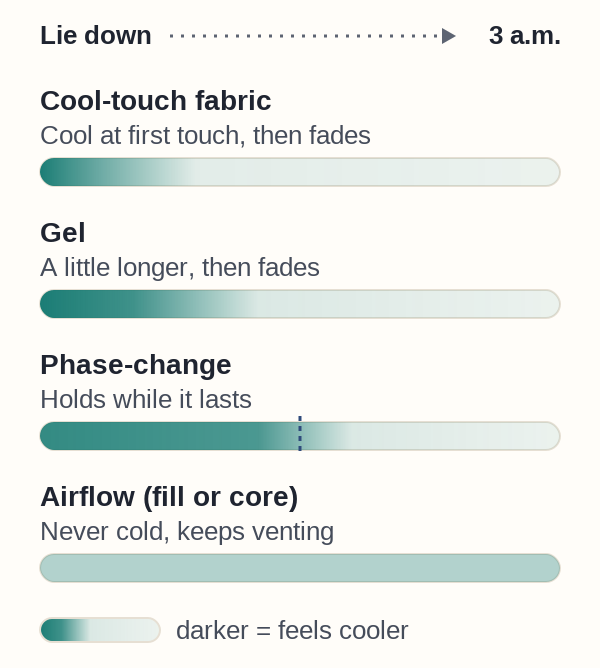
Every cooling pillow works in one of four ways, and they behave very differently over a night.
1. Cool-touch fabrics
Covers sold as “cool to the touch” are engineered to pull heat from your skin quickly. The textile industry has a number for this, called Qmax or the contact cooling coefficient. One study describes the effect as “rapid heat exchange from the skin surface to the fabric, causing an instantaneous drop in skin surface temperature,” and notes that China’s textile standard (GB/T 35263-2017) counts a Qmax of 0.15 or higher as good contact cooling (Zhao et al., 2024).
Notice the word “instantaneous.” Qmax measures the first touch. It doesn’t tell you how a cover feels after your head has rested on it for an hour.
2. Gel
Gel layers and gel-infused foam feel cool because gel draws heat away from your skin; the Sleep Foundation describes gel as having “a cool-to-the-touch feel” (Sleep Foundation). But gel holds a limited amount of heat, so it warms toward your skin’s temperature.
How fast? We found no independent measurement. The closest thing is an informal home test by Hullo, a company that sells buckwheat pillows (so read it with that in mind). Its writer found one gel pillow’s cool layer warmed “in less than ten minutes,” and a water-filled insert “felt cool for about a half an hour” (Hullo). That’s one person, a night or two per product, and not a lab.
3. Phase-change materials (PCM)
Phase-change materials, sold under names like Outlast, absorb heat while they melt at a set temperature and give it back as they solidify. It’s real physics, but it’s a reservoir, not a refrigerator. Researchers put it simply: the effect “is dependent on temperature and time,” and the capacity “is related to the amount of PCM used” (Yan et al., 2021). Once the material has fully changed phase, it stops buffering. A thin coating on a cover holds less than a thick layer inside a pillow.
4. Airflow
Vented latex, shredded fills and buckwheat hulls don’t feel cold. They let warm air move away from your head instead of pooling around it. The Sleep Foundation’s testers note that “a solid piece of foam will generally retain more heat than shredded foam, as air can better move around the space in the fill” (Sleep Foundation). This is the one mechanism that doesn’t rely on a material staying colder than you, so it has nothing to run out of. If your pillow is solid memory foam, our guide to what to do when a memory foam pillow is too hot compares the fills.
What the research actually shows
There is real evidence that a cooler head can help in a hot room. Look closely at how those studies cooled people, though:
- Kept cold all night. In a study of 14 young women, a sheet with circulating water held at 25°C (77°F) cooled the head; the share of time spent aroused was lower and deep sleep higher than with the sheet held at 35°C (95°F) (Hamanishi et al., 2019). A pillow on your bed has no pump.
- Hot, humid rooms. In nine young men sleeping at 32°C and 80% humidity, time awake with a cooling pillow was no longer significantly different from sleep in a comfortable room, and whole-body sweating was lower (Okamoto-Mizuno et al., 2003).
- Head alone isn’t much. In 16 men at 32°C, cooling the head and neck alone “slightly improved thermal comfort and subjective sleep quality”; cooling the back and head together worked best (Lan et al., 2018).
- The one passive pillow study we found is small and old: five female students slept on a pillow with a “special cool medium” of sodium sulfate and ceramic fiber versus a polyester pillow, in a room at about 27°C (81°F). Forehead skin temperature stayed lower during the latter half of the night, and all five preferred it for deeper sleep (Kawabata & Tokura, 1996).
And the big picture is humbling. A 2025 review pooled nine randomized trials of bedding that cools the body (mattresses, toppers, pillows). The included studies suggested the bedding did cool the body, but the review found “no differences” in sleep measures like time to fall asleep, sleep efficiency or time awake, with certainty of evidence rated “very low to low” (Pasquier et al., 2025; we read the abstract).
Even studies of cooling bedding tend to be early-stage. A 2025 pilot of one brand of cooling sheets found people reported sleeping better after switching, but it had no comparison group, it was supported by the sheet maker, and its authors say the findings “warrant replication in a randomized, placebo-controlled design” (Weaver et al., 2025).
What doesn’t exist, as far as we could find: an independent, readable test that measures retail cooling pillows overnight. Makers’ numbers, like “reduces heat buildup by up to 50%,” come without a published setup. Treat any “stays cool for X hours” claim as marketing until someone shows the test.
Cooling pillow or cooling pillowcase: which to fix first
Start with the cheapest fix that matches where the heat is.
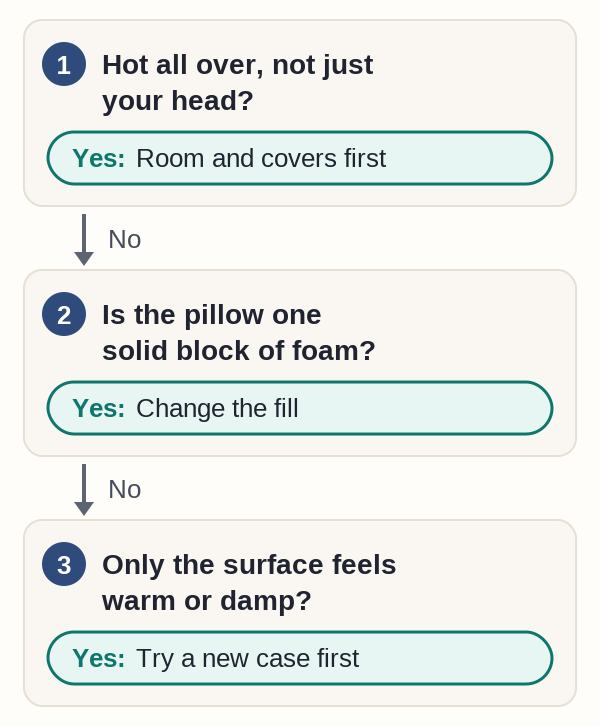
- Hot all over? The pillow is a small part of it. NHLBI’s advice is a bedroom that’s “quiet, cool, and dark” (NHLBI). Look at the room, the duvet and the mattress first; if you share the bed with a cold partner, see the two-duvet fix, and if a foam topper is the problem, see what to do when a memory foam topper sleeps hot.
- Solid foam pillow? A cooler case only changes the surface. The fill is still trapping heat.
- Only the surface feels warm or damp? Try a breathable or cool-touch case before buying a pillow. A thick or fleece case adds a layer between you and the air; if you’re weighing silk, see whether a silk pillowcase sleeps hot.
The 3 a.m. test
You can check a cooling pillow (or your current one) better than any label can.
- At bedtime, note the first feel. Cold, neutral or warm? This is the part the marketing sells.
- When you wake in the night, don’t flip it yet. Put your palm where your head was, then on a part of the pillow you haven’t touched. Is your spot clearly warmer, or damp?
- Now flip it. If the fresh side feels great and you drift off, the surface had simply warmed up. That’s normal for any pillow; a “cooling” one that does the same at 3 a.m. isn’t doing much more.
- Repeat for a week. One hot night tells you about the weather, not the pillow. Use the trial period while you test.
If your spot is damp as well as warm, airflow matters more than a cold feel. If it’s warm but dry and the cool side fixes it, a phase-change or cool-touch cover may be enough.
Which pick for which hot sleeper
- You wake up hot after midnight: go for airflow, like a vented latex core, shredded latex or buckwheat. It won’t feel cold, but it keeps venting.
- You love memory foam and mostly struggle to fall asleep warm: a gel foam pillow with a phase-change layer and a cool-touch cover gives the strongest first chill.
- You want soft and squishy, not foam: a fiberfill pillow with a phase-change cover.
- Your pillow is fine, the surface isn’t: change the case first.
- Whatever you buy, get the height right. A cool pillow at the wrong height won’t help; see how to tell if your pillow is too high or too low.
Is there truly a pillow that stays cold?
Not on its own. Anything that feels cold works by taking heat from you, so it warms up as it does. The only things that stay cold all night are powered devices, like the circulating-water sheet in the 2019 study above. A pillow that vents well will feel neutral rather than cold, which is often what “cool all night” really means.
Why is my cooling pillow not cold anymore?
Usually because it has done its job: the gel, phase-change layer or cool-touch fabric has soaked up all the heat it can and is now close to your skin’s temperature. A thick case or a waterproof protector can also block a cool-touch cover from touching your skin. Left uncovered in a cool room during the day, it should give off that heat and feel cooler again at bedtime.
Should you put a pillowcase on a cooling pillow?
Yes, for hygiene, but choose a thin, breathable one. Slumber Cloud, for example, says its UltraCool Pillow is “designed to manage heat through your pillowcase.” The thicker or less breathable the case, the less of a cool-touch surface you’ll feel. Skip a waterproof protector unless you need one.
When to look beyond the pillow
If you wake up soaked, not just warm, bedding is unlikely to be the whole answer. Cleveland Clinic advises: “Schedule a visit with a healthcare provider if you have night sweats that disrupt your sleep” (Cleveland Clinic). For comfort-only bedding ideas, see bedding for night sweats.
How we researched this
This is a research comparison, not a hands-on test. We haven’t slept on these pillows ourselves. We read the textile studies on cool-touch fabrics and phase-change materials, the head-cooling sleep studies and a 2025 review (some as abstracts or the parts we could read, which we note in our sources), the Sleep Foundation’s testing notes and the top-ranking articles on this question. We checked each product’s materials, sizes and terms on the maker’s own website on November 18, 2026. Cooling claims in the picks are the makers’ own and are marked as such. We list no prices because they change; check the seller’s page.
Our picks
Brooklyn Bedding Talalay Latex Pillow
ventilated Talalay latex pillow
- Best for
- Hot sleepers whose problem is waking up warm later in the night, and who like a springy feel
- Why it won
- A Talalay latex core with what the maker calls 'tiny breathable airways', in a TENCEL lyocell cover. It doesn't rely on a material that feels cold; it relies on air moving through the core, which is the one approach that doesn't run out as the night goes on. Two lofts: Low for back and stomach sleepers and High for side sleepers, per the maker. The cover is machine washable and the latex is spot clean only. 30-day returns on pillows and a 3-year warranty, per the maker's FAQ.
- Watch out
- It won't feel cold when you lie down. The maker's page gives two sets of heights (5.5 and 7 inches in the product text, 4 and 5 inches in a customer Q&A answer), so check before you buy. It's latex: if you have a latex allergy, ask your doctor first. Some reviewers on the page found it too soft or too bouncy.
- What it beat
- Picked over the gel and phase-change options for readers who wake up hot after midnight, because airflow doesn't depend on a material staying colder than your skin. Lost to them on the cold first feel.
GhostPillow Gel Memory Foam
gel memory foam pillow with a phase-change layer and a cool-touch cover
- Best for
- Memory foam lovers who want the strongest cool feel when they first lie down
- Why it won
- It stacks every cooling approach in one pillow: a ventilated gel memory foam core, a layer of phase-change material and the maker's 'cool-to-the-touch' Ghost Ice cover. The maker's own FAQ describes the split plainly: 'The Ghost Ice cover provides an instant chill, while the inner materials maintain your body temperature.' CertiPUR-US certified foam, a zippered cover you machine wash cold and line dry, and a 5-year warranty.
- Watch out
- It's still a solid block of memory foam, the build the Sleep Foundation says generally holds more heat than shredded fill, and it isn't adjustable (the maker says most customers call it medium loft). The maker promises 'continuous temperature regulation throughout the night'; we found no independent measurement of that. Its 101-night trial asks you to sleep on it 30 nights before a return, and you pay the return shipping. Expect a new-foam smell at first, per the maker.
- What it beat
- Picked over plain gel foam pillows because it adds vents and a phase-change layer; lost to the latex pillow for readers whose problem is waking hot at 3 a.m.
Slumber Cloud UltraCool Pillow
down-alternative pillow with a phase-change (Outlast) cover
- Best for
- Back and side sleepers who want a soft, squishy pillow rather than foam or latex
- Why it won
- The cooling is in the cover: a polyester knit coated with Outlast, a phase-change material, on both sides, over polyester fiberfill. Phase-change materials soak up heat as they melt, which buffers warmth for a while. Two firmness levels (Soft/Medium and Medium/Firm), Standard and King sizes, machine washable as a whole, OEKO-TEX Standard 100 certified, with a 30-night trial.
- Watch out
- The maker says it reduces 'heat buildup by up to 50%', but its page doesn't say how that was measured, so we can't weigh it. Textile research says a phase-change layer's capacity depends on how much material it holds, and a coating holds a limited amount. The fill isn't adjustable. The maker says the pillow is 'designed to manage heat through your pillowcase', so pair it with a thin case.
- What it beat
- Picked over the GhostPillow for people who don't want memory foam; lost to the latex pillow for 3 a.m. heat, because its cooling depends on a coating rather than air moving through the core.
SHEEX Arctic Aire MAX Pillowcase
TENCEL lyocell cooling pillowcase
- Best for
- Anyone whose pillow is fine but whose face meets a warm or damp surface, as the cheapest first step
- Why it won
- 100% TENCEL lyocell, which the maker calls its coolest fabric for people who like the feel of cotton. It's one of the few cases whose maker publishes a 'QMAX (cool-to-the-touch) Rating', the textile measure of first-touch coolness explained below; SHEEX labels it 'Balanced Cool Feel' rather than giving a number. Standard and King sizes, with a 60-night guarantee.
- Watch out
- A Qmax rating describes the first touch, not how the case feels hours later. The page calls the fabric both a 'sateen weave' and a 'breathable knit', so we can't tell you which it is. A case can't fix a solid foam pillow underneath. Some sizes and colors showed as unavailable when we checked.
- What it beat
- Picked over a new cooling pillow as the first thing to try when only the surface feels warm; lost to a new pillow when the fill itself traps heat.
Watch
- Do cooling pillows actually work? Judge them at 3 a.m. (YouTube Short, 0:32)
Sources
- The Development and Performance of Knitted Cool Fabric Based on Ultra-High Molecular Weight Polyethylene (Zhao et al., 2024), Polymers (MDPI), via PubMed Central
- Thermo-Physiological Comfort Properties of Sportswear with Different Combination of Inner and Outer Layers (Atalie et al., 2021), Materials (MDPI), via PubMed Central
- Flexible Phase Change Material Fiber: A Simple Route to Thermal Energy Control Textiles (Yan et al., 2021), Materials (MDPI), via PubMed Central
- Effects of Two Kinds of Pillow on Thermoregulatory Responses during Night Sleep (Kawabata & Tokura, 1996), Applied Human Science (Journal of Physiological Anthropology)
- Effects of head cooling on human sleep stages and body temperature (Okamoto-Mizuno et al., 2003), International Journal of Biometeorology
- Local body cooling to improve sleep quality and thermal comfort in a hot environment (Lan et al., 2018), Indoor Air
- Head cooling during sleep improves sleep quality in the luteal phase in female university students: A randomized crossover-controlled pilot study (Hamanishi et al., 2019), PLOS ONE
- Does body cooling facilitated by bedding compared to control condition improve sleep among adults (18–64 years old)? A systematic review and meta-analysis (Pasquier et al., 2025), Journal of Thermal Biology
- A non-randomized pre-post pilot study of cooling bed sheets in hot sleeping people (Weaver et al., 2025), Frontiers in Sleep
- Best Cooling Pillows (how cooling pillows work, materials; updated Oct 26, 2026), Sleep Foundation
- Does That "Cooling Pillow" Really Work? I Tried Four. (updated Oct 25, 2024), Hullo (a buckwheat pillow maker)
- Healthy Sleep Habits, National Heart, Lung, and Blood Institute (NIH)
- Night Sweats, Cleveland Clinic