Pillow Too High or Too Low? A Simple Check, and How to Fix It
This guide contains affiliate links. We may earn a commission if you buy through them, at no extra cost to you. How that works.
In short
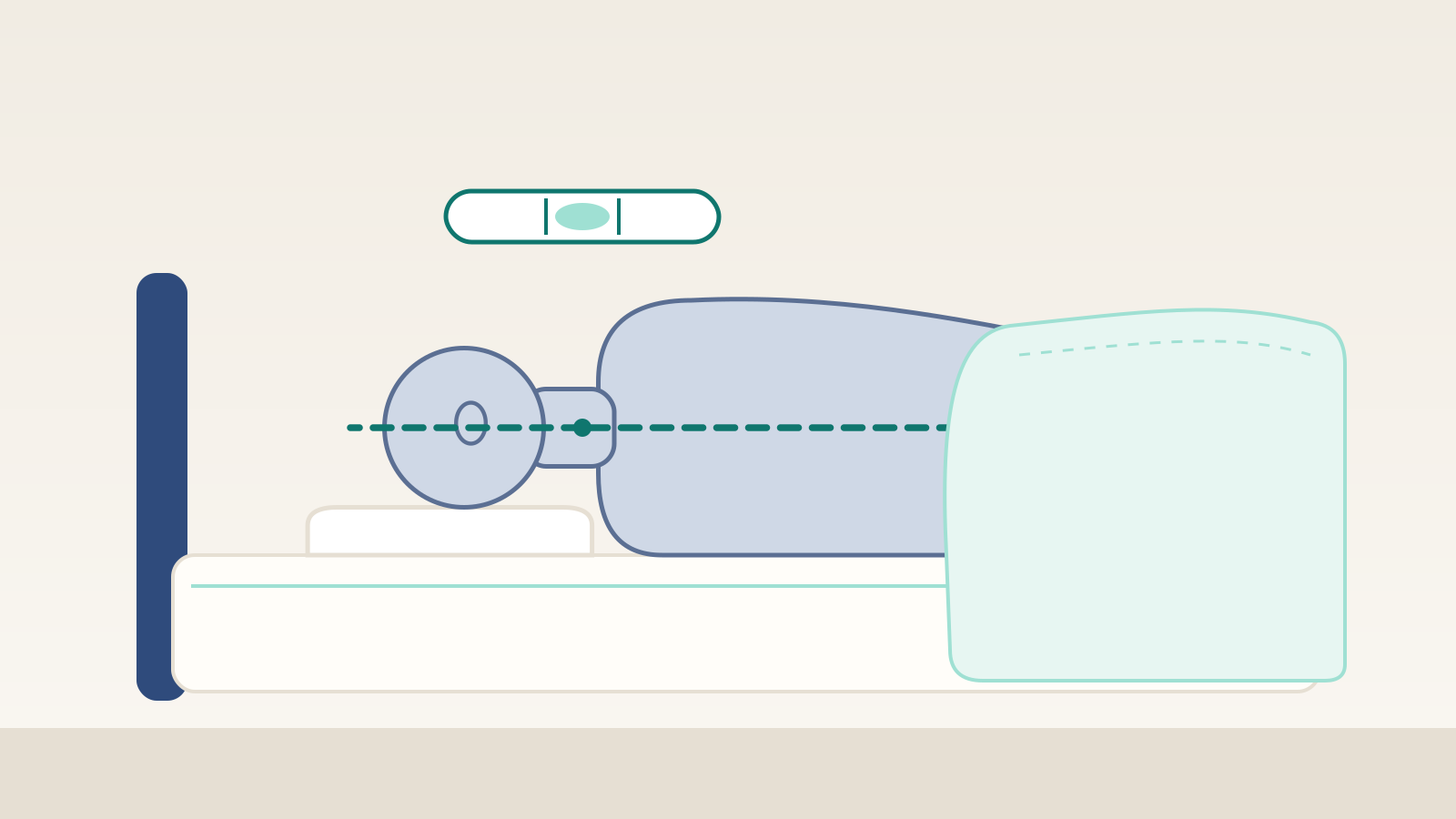
Your pillow is too high if your head tips up away from the mattress when you lie on your side, or your chin is pushed toward your chest on your back. It's too low if your head droops toward the mattress on your side, or your jaw points at the ceiling on your back. The goal is a head that sits level with the rest of your body. No study has found one correct height for everyone, so check yourself rather than trusting a number.
The short answer
Your pillow is too high or too low if your head doesn’t sit level with the rest of your body. On your side, a pillow that’s too high tips your head up, away from the mattress; one that’s too low lets it droop toward the mattress. On your back, a pillow that’s too high pushes your chin toward your chest; one that’s too low lets your jaw point at the ceiling.
Below: a simple check you can do tonight for each sleep position, what the research actually says about pillow height (less than most pillow brands suggest), the things that change how high you need, and how to fix a wrong pillow before you buy a new one.
What “right” looks like
Health sources describe the same target in slightly different words:
- Cleveland Clinic says a proper pillow “should keep your neck parallel to the mattress, rather than bent down or up” (Cleveland Clinic).
- The NHS advises: “when sleeping, make sure your head is the same height as the rest of your body” (NHS).
- The Sleep Foundation suggests a pillow that “cradles your neck without an exaggerated angle tilting up or down” (Sleep Foundation).
- A physical therapist at Ohio State describes neutral as head and neck in “a straight, aligned position, without any major tilting forward, backward, or to the side” (Ohio State Wexner Medical Center).
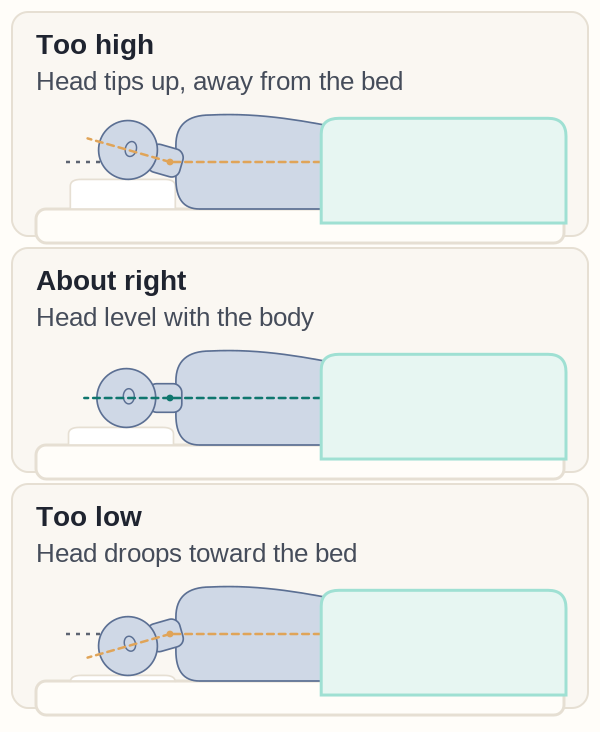
The check: is your pillow too high or too low?
You need your usual pillow, your usual mattress and a second person (or your phone on a timer).
If you sleep on your side:
- Lie down on your side the way you normally fall asleep, knees slightly bent.
- Give it a few minutes before you judge. In a lab study of 24 young women, most people’s necks had settled by 15 minutes on the pillow (Hodkinson et al., 2013), so a quick glance the moment you lie down can mislead.
- Have someone look at you from the front, or take a photo. Imagine a line from the middle of your back, through your neck, to the middle of your head.
- Head tilted up toward the ceiling: too high. Head drooping toward the mattress: too low. Cleveland Clinic’s version: the pillow “should also be thick enough to support your head and neck without letting it droop down” (Cleveland Clinic).
If you sleep on your back:
- Lie on your back on your usual pillow.
- Check where your jaw points. Cleveland Clinic: “A pillow that’s too low will send your jaw pointing toward the ceiling; too high, and your jaw aims toward your chest” (Cleveland Clinic).
- Ohio State’s physical therapist puts it another way: your head shouldn’t be “pushed forward by the pillow or forced to reach for the pillow” (Ohio State).
If you sleep on your stomach:
There’s little to check: the lower the better. The Sleep Foundation says stomach sleepers “usually prefer a very thin pillow, though some stomach sleepers opt to use no pillow at all” (Sleep Foundation), and Ohio State suggests “a short-height pillow to avoid having your neck extended while rotated.” The NHS goes further for people with neck pain: “do not sleep on your front.”
An honest caveat: no study has tested a home check like this against a real measurement. One trial put it bluntly: for a neutral neck position, “no information is available about how to achieve such a position” (Gordon et al., 2011). Treat the check as a good first look, then judge by a few nights of sleep.
What the research says about pillow height
Less than you’d think, and that’s useful to know before you buy a pillow sold on a number.
- The best review says there’s no answer. A 2021 review of pillow-height research concluded: “there remain no firm conclusions about the optimal pillow height for the supine and lateral positions” (Lei et al., 2021).
- Two small studies landed on about 10 cm (3.9 inches). In 21 young adults lying on their side, a 10 cm foam pillow felt most comfortable of three heights (5, 10 and 14 cm), and neck muscle activity was highest on the 5 cm one (Sacco et al., 2015). In 16 young adults lying on their back, X-rays led the authors to suggest 10 cm, while warning that “this value is not an absolute figure” (Kim et al., 2015).
- A review of pillow designs found moderate evidence for “a seven to eleven centimeters height of the unloaded central part of the pillow,” about 2.8 to 4.3 inches before your head presses it down (Radwan et al., 2021).
- Your body measurements may not predict it. In one study of 29 healthy adults, the authors concluded that “anatomical body measurements are not good predictors of optimal pillow height” (Wang et al., 2015).
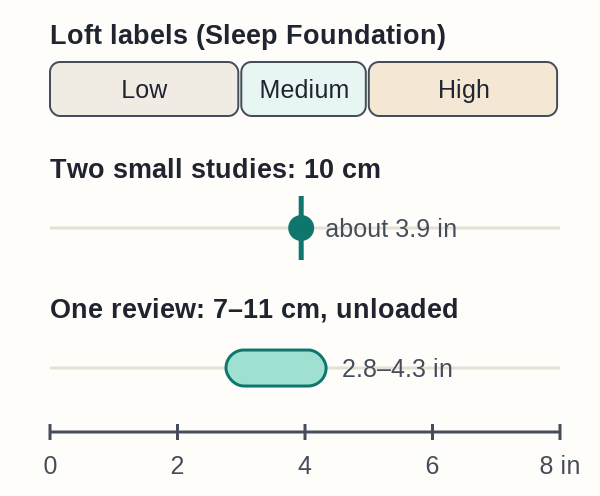
Why this matters when you shop: makers list heights of 5, 6 or 7 inches, while the studies above sit around 4 inches. They’re not measuring the same thing. The review notes that foam and buckwheat “can be compressed in the experiment, and the actual height cannot be determined” (Lei et al., 2021), and a listed height is usually the pillow before anyone lies on it. That’s why the check above beats any number.
For reference, the Sleep Foundation sorts pillows into low loft (under 3 inches), medium (3 to 5) and high (over 5) (Sleep Foundation). These are common labels, not an industry standard.
What changes how high you need
- Your sleep position. Side sleepers usually need the most height and stomach sleepers the least. The Sleep Foundation says back sleepers “tend to prefer mid-loft pillows between 3 and 5 inches thick” (Sleep Foundation).
- The gap at your shoulder. On your side, “having enough height to bridge the gap created by your shoulder is important” (Ohio State). The Sleep Foundation’s version: a loft “that matches the distance between your neck and your shoulder” (Sleep Foundation).
- Your mattress. “If you have a firmer mattress, you’ll need a thicker pillow because your shoulder won’t sink into the mattress very much” (Cleveland Clinic). A new, softer mattress or topper can make a pillow that was right feel too high.
- Your weight on the pillow. “Sleepers in higher weight ranges may need pillows with more loft,” because the pillow compresses more (Sleep Foundation).
- If you switch positions, pick for the position you spend most of the night in, or choose an adjustable pillow you can set in between.
How to fix it tonight, before you buy anything
- Too low on your side? Fold a towel in half, lay it under your pillow and check again. Add or remove a fold until your head sits level. If you need a lot of towel, that’s your sign the pillow is too thin.
- Too high? If your pillow has a zipper, take out a handful of fill and sleep on it for a night before taking out more. If it’s solid foam or latex, there’s no fixing it; try a thinner pillow you already own.
- Stacking two pillows? If one feels too flat and two feel too high, try one pillow plus a folded towel instead.
- Is the pillow just worn out? “Most experts recommend replacing pillows every 1 to 2 years,” according to the Sleep Foundation, and for down and feather pillows it suggests a fold test: if the pillow “doesn’t spring back to its normal shape after you fold it in half,” replace it (Sleep Foundation).
Once you’ve found the height that works with towels, measure the stack. It tells you roughly what to look for in a new pillow, keeping in mind that a new pillow’s listed height is measured before it compresses.
Which pillow for which sleeper
- Side sleepers: usually the tallest of the three. An adjustable pillow kept full, or the taller settings of a pillow sold in heights. The makers we checked size their tallest options for side sleepers with larger frames.
- Back sleepers: a middle height, low enough that your chin isn’t pushed down.
- Stomach sleepers: a very thin pillow or none. An adjustable pillow with most of the fill removed, or one made thin.
- Combination sleepers: an adjustable pillow, set for the position you spend most of the night in.
Is it better to sleep on a high or low pillow?
Neither: the right height is the one that keeps your head level with your body in the position you sleep in. In one small study, the lowest of three pillows (5 cm) was the least comfortable for side sleeping and had the highest neck muscle activity (Sacco et al., 2015), so “lower is better” doesn’t hold for side sleepers. For stomach sleepers, thinner is generally better.
What happens when your pillow is too high?
Your neck spends the night bent. The review above notes that “a pillow that is too high can cause the cervical spine to bend forward,” and one that’s too low lets it stretch backward (Lei et al., 2021). Harvard Health advises avoiding “too high or stiff a pillow, which keeps the neck flexed overnight” (Harvard Health).
Should your shoulders be on your pillow?
When you lie on your side, your pillow fills the space between your head and the mattress, above your shoulder. That gap is what Ohio State means by bridging “the gap created by your shoulder.” Pushing your shoulder up onto the pillow changes the height you need, so check yourself in the position you actually sleep in.
When to see a professional
A better pillow is a comfort fix, not a treatment. If neck pain doesn’t go away after a few weeks, the NHS advises seeing a GP (NHS); in the US, see your doctor or a physical therapist.
If your pillow is the right height but sleeps hot, see what to do when a memory foam pillow is too hot. If you share the bed with someone who runs cold, see the two-duvet fix.
How we researched this
This is a research comparison, not a hands-on test. We haven’t slept on these pillows ourselves. We read the studies above (several only as abstracts, where the full paper is paywalled) and the guidance pages from Cleveland Clinic, the NHS, Ohio State, Harvard Health and the Sleep Foundation, and we say where the research doesn’t give an answer. We checked each pillow’s heights, materials and terms on the maker’s own website on November 18, 2026. Heights are the makers’ figures. We list no prices because they change; check the seller’s page.
Our picks
Purple DreamLayer Pillow
foam pillow with two removable 1-inch layers
- Best for
- Side and back sleepers who want to test three heights with one pillow
- Why it won
- It comes with two removable 1-inch booster layers, so you can sleep on it at three heights: 5 inches with no booster, 6 with one, 7 with two, according to the maker. The maker suggests the low setting for back sleepers and people with small-to-medium frames, and the taller settings for side sleepers with larger frames. A polymer grid on top of a foam core; the cover is machine washable.
- Watch out
- Even the lowest setting is 5 inches by the maker's measure, which is the top of the Sleep Foundation's 'medium' range, so it's likely too tall for most stomach sleepers. The page states a 30-night trial and a 1-year warranty; check the current terms. The maker says new foam may smell for 24–48 hours.
- What it beat
- Beat fill-adjustable pillows for people who want to know exactly what they changed, because each step is a stated 1 inch; lost to the Avocado for stomach sleepers, who need to go much lower.
Avocado Green Pillow
adjustable shredded latex and kapok pillow
- Best for
- Anyone who wants to fine-tune the height a little at a time, including stomach sleepers
- Why it won
- You unzip the inner liner and take out or add fill (shredded organic latex and kapok); an extra bag of fill comes with it. The maker gives the clearest guidance we found: side sleepers keep the fill high, back sleepers reduce it to a medium level, and stomach sleepers remove fill until the pillow is nearly flat. It arrives overfilled on purpose, and the maker suggests removing a small handful at a time and sleeping on it for a night before adjusting again. 100-night trial; certified GOTS organic, OEKO-TEX and GREENGUARD Gold.
- Watch out
- No heights in inches, so you set it by feel and by the check below. It contains latex. The page gives two different care instructions; plan on the cover being washable and the inner liner spot clean only.
- What it beat
- Beat the Purple DreamLayer for stomach sleepers and anyone who wants small steps; lost to it for people who'd rather change a known amount than guess.
Purple Harmony Pillow
latex pillow sold in three fixed heights
- Best for
- People who already know roughly how high they need and want to buy it once
- Why it won
- Sold in three fixed heights: Low 5.5 inches, Medium 6.5 and Tall 7.5, according to the maker, with a sleep-position and frame-size guide for each (Low for back and stomach sleepers with small-to-medium frames; Medium and Tall for side sleepers, by frame size). Talalay latex core under a stretchy polymer grid; the cover is machine washable.
- Watch out
- It isn't adjustable: if you pick the wrong height, your only option is a return. Same maker as the DreamLayer. It contains latex (the maker calls it unlikely to bother a latex allergy and suggests asking your doctor if you're concerned). The page states a 30-night trial; check the current terms.
- What it beat
- Picked over the adjustable options for readers who don't want to tinker; lost the top spot because adjustable pillows let you correct a wrong guess.
PineTales Ultra Thin Latex Pillow (Stomach Sleeper Edition)
thin latex pillow for stomach sleepers
- Best for
- Stomach sleepers, and back sleepers who like a very low pillow
- Why it won
- A fixed 2-inch latex core; the maker notes that's the thickness before use and that the latex compresses under your head. The maker says it's made for stomach sleepers who want cushioning with very little lift, and warns side sleepers to check whether it gives them enough height. Removable, washable cover.
- Watch out
- No returns at all (the maker calls it a hygiene policy). It's 12 x 20 inches, smaller than a standard pillow. No certifications listed on the page.
- What it beat
- Picked over every taller pillow for stomach sleepers, who the Sleep Foundation says usually prefer a very thin pillow; lost the general spot because nobody else needs it this low.
Watch
- Is your pillow too high? Check this one line tonight (YouTube Short, 0:27)
Sources
- Ergonomic Consideration in Pillow Height Determinants and Evaluation (Lei et al., 2021), Healthcare (MDPI), via PubMed Central
- The effect of pillow height on muscle activity of the neck and mid-upper back and patient perception of comfort (Sacco et al., 2015), Journal of Manipulative and Physiological Therapeutics
- The Effect of Different Pillow Heights on the Parameters of Cervicothoracic Spine Segments (Kim et al., 2015), Korean Journal of Spine
- Effect of different pillow designs on promoting sleep comfort, quality, & spinal alignment: A systematic review (Radwan et al., 2021), European Journal of Integrative Medicine
- Effect of pillow size preference on extensor digitorum communis muscle strength and electromyographic activity during maximal contraction in healthy individuals: a pilot study (Wang et al., 2015), Journal of the Chinese Medical Association
- A randomized, comparative trial: does pillow type alter cervico-thoracic spinal posture when side lying? (Gordon et al., 2011), Journal of Multidisciplinary Healthcare
- Time to stabilisation of the cervical spine when supported by a pillow in side lying (Hodkinson et al., 2013), Ergonomics
- Best Sleeping Positions for Pain, Cleveland Clinic
- Is Your Pillow Giving You a Stiff Neck? 7 Tips for Better Sleep, Cleveland Clinic
- How to choose a pillow, The Ohio State University Wexner Medical Center
- Neck pain, NHS
- Say good night to neck pain, Harvard Health Publishing
- Sleeping Positions (updated Jul 25, 2025), Sleep Foundation
- How Many Pillows Should You Sleep With? (loft categories), Sleep Foundation
- How to Shop for Pillows, Sleep Foundation
- How Often Should You Replace Your Pillow?, Sleep Foundation