Hot Sleeper, Cold Partner? The Two-Duvet Bedding Fix
This guide contains affiliate links. We may earn a commission if you buy through them, at no extra cost to you. How that works.
In short
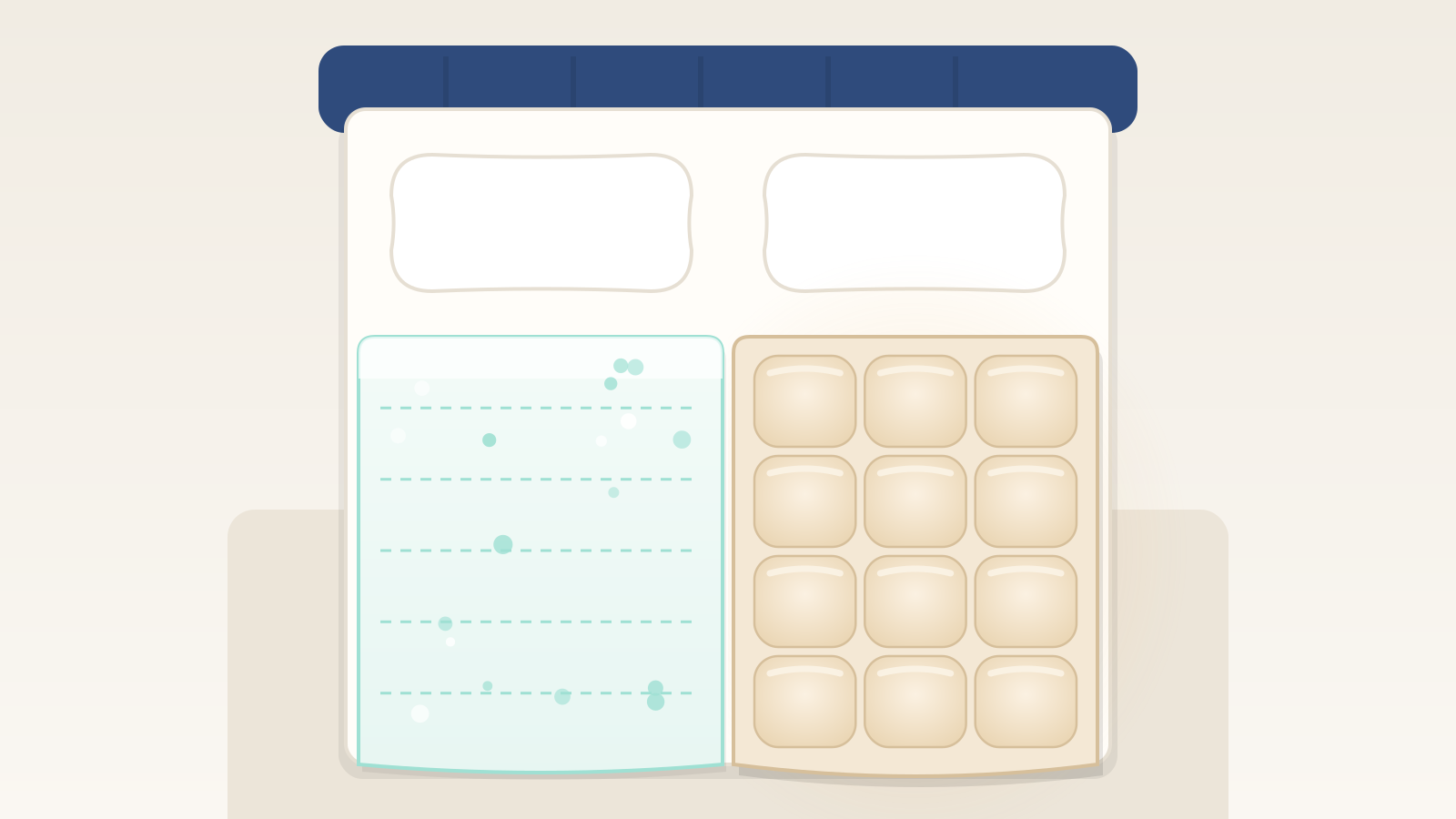
If you run hot and your partner runs cold, stop sharing one duvet. Keep one fitted sheet and give each of you your own twin-size duvet: a lightweight one for the hot sleeper, a warmer one for the cold sleeper. Buy both weights from the same product line so they match in size and look, and keep the room on the cool side so the warm one can always add a layer.
The short answer
If you’re a hot sleeper with a cold partner, the most direct bedding fix is to stop sharing one duvet. Keep one fitted sheet on the mattress and give each of you your own twin-size duvet: a lightweight one for the person who runs hot, a warmer one for the person who runs cold. Buy both weights from the same product line so they match, and keep the room on the cool side, because the cold sleeper can always add warmth and the hot sleeper can’t take off more than nothing.
Below: why two people feel the same room so differently, how to size two duvets for a queen or king, how to pick each weight, what to try before you buy anything, and when two duvets aren’t enough.
Why you and your partner feel the same bed so differently
If one of you is kicking the covers off while the other is pulling them up, you’re not imagining it, but the research is less tidy than most bedding pages suggest.
- A review of thermal-comfort studies, done in buildings rather than bedrooms, found women were more likely than men to say they were uncomfortable with the temperature, and “more sensitive than males to a deviation from an optimal temperature,” especially when it’s cool. It also found that “most studies found no significant difference in neutral temperatures between the genders” (Karjalainen, 2012). Its conclusion fits a shared bed well: women “have, on average, a greater need for individual temperature control.”
- A short paper in Nature Climate Change argued that office comfort standards are based on an average man’s metabolic rate and “may overestimate female metabolic rate by up to 35%” (Kingma & van Marken Lichtenbelt, 2015). That’s a criticism of a building model, not a measurement of how warm women sleep.
So don’t read this as “women run cold, men run hot.” Plenty of couples are the other way round. What the research does support is simpler: people differ in how they feel the same temperature, and the person who feels it most benefits from control over their own side.
We couldn’t find a study that measures how far apart partners’ preferred bed temperatures are. Treat any number you see for that with suspicion.
Why the duvet is the right thing to split
The room is shared. The mattress is shared. The duvet is the one layer that can be different on each side, and it does a lot of the work.
- In a sleep-lab study of 16 people (8 men, 8 women) sleeping through the night under quilts of different fills and weights, the room temperatures they found comfortable “had good linear correlations with bedding insulations.” In plain terms, a warmer quilt moved their comfortable room temperature down (Zheng et al., 2022).
- A second study of 12 people found that warmer duvets “widened the thermal comfort zone of ambient temperature,” and suggested a temperature under the covers of about 86–91°F (30–33°C) for comfortable sleep (Yan et al., 2023).
- A review of the research on heat and sleep explains why: bed covers create their own warm pocket of air, and “in real-life situations where bedding and clothing are used, heat exposure increases wakefulness and decreases slow wave sleep and rapid eye movement sleep” (Okamoto-Mizuno & Mizuno, 2012). The same review notes that in real life, being too cold may disturb sleep even more than being too hot. Both of you have a real problem, not just the one who complains loudest.
Put together: if two people share one duvet, at least one of them has the wrong amount of insulation all night. Two duvets let each of you set your own.
The two-duvet fix (the “Scandinavian sleep method”)
The setup has a name online. The Sleep Foundation describes the Scandinavian sleep method as couples using “two separate duvets to lessen sleep disruption,” named after a sleeping style popular in Sweden, Norway and Denmark, and says it “allows each person to regulate their own temperature at night” (Sleep Foundation). It went viral through a post by the Swedish creator Cecilia Blomdahl. In a 2024 survey of about 2,000 US adults for the American Academy of Sleep Medicine, 10% said they had tried it (AASM, 2024).
How to set it up:
- Keep one fitted sheet. You still share the mattress. The method typically skips the top sheet (Sleep Foundation).
- Give each person their own duvet, usually twin size (see sizing below), each in its own duvet cover.
- Choose each weight separately: light for the hot sleeper, warmer for the cold sleeper.
- Make the bed: fold each duvet in half lengthwise on its own side, or lay a single throw across the foot of the bed during the day if you want it to look like one bed.
What it won’t fix: the Sleep Foundation lists the downsides honestly. It’s harder to cuddle, it does nothing about snoring or sleep talking, and you’ll still feel the mattress move when your partner turns over.
Sizing: two duvets on a queen or a king
The Sleep Foundation says “most couples choose two twin size duvets or two twin XL duvets.” That works on both a queen and a king, because a twin duvet is much wider than half a mattress.
Here’s the arithmetic, using the makers’ own size charts (checked November 18, 2026):
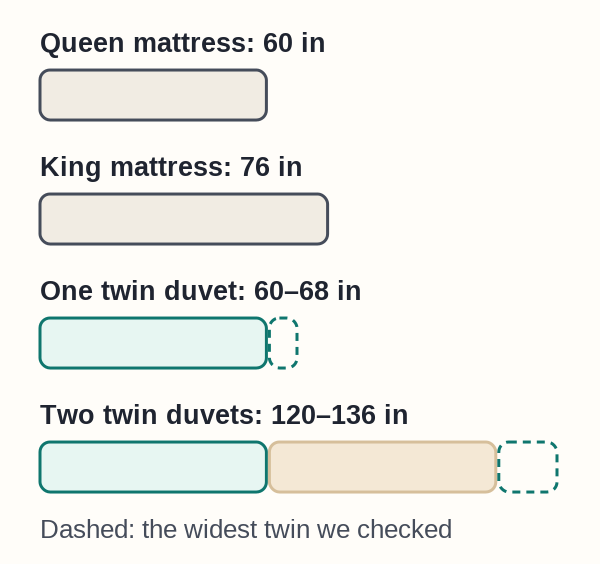
- A queen mattress is 60 inches wide, and a king is 76 inches wide (Brooklinen’s fitted-sheet sizes).
- The twin duvets we checked are 60 to 68 inches wide each: Parachute 60, Woolroom 66, Brooklinen 68.
- So two twins together are 120 to 136 inches across. That’s enough to drape over both sides of either bed and still overlap in the middle.
Three practical points:
- On a queen, a narrower twin overlaps less in the middle. If you’ll be making the bed every morning, that’s tidier.
- Many makers sell one “Twin/Twin XL” duvet size (Brooklinen and Parachute do), so you often don’t have to choose.
- Skip two full/queen duvets. One alone is about 90 inches wide (Parachute 90, Brooklinen 92), so two would be three times the width of a queen mattress.
How to pick each weight
US bedding doesn’t use a single warmth scale, which makes mixing brands a guessing game.
- In the UK, duvet warmth is a tog rating: a measure of thermal resistance, tested under a British Standard (BSI).
- US makers mostly use their own labels (lightweight, all-season, warm, heavyweight), and for down, fill power, which “measures the loft or insulation properties of down products” (IDFL).
- We found no standard that defines “lightweight” or “all-season,” and no reliable conversion between tog and fill power. One brand’s lightweight can be another’s all-season.
So the rule is: buy both duvets from the same product line, one weight apart or two. Within one line, “lighter” and “warmer” mean something, and the two duvets match in size and look. Then use the maker’s own room-temperature guidance if it gives one:
- The hot sleeper: the lightest weight in the line.
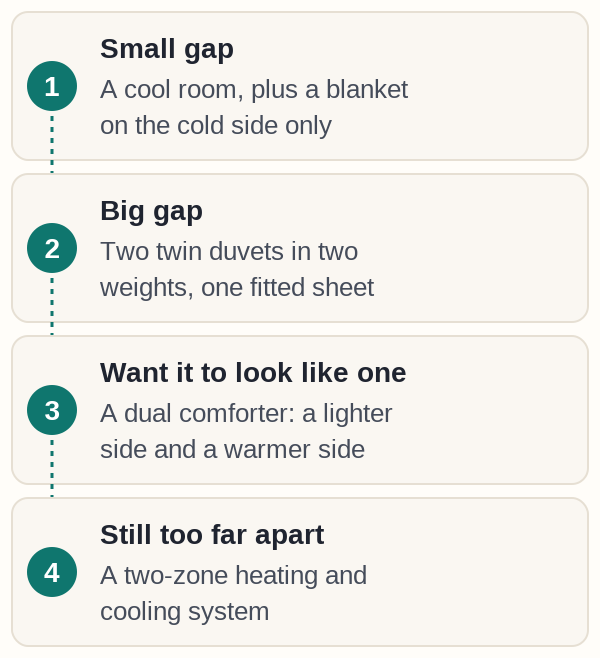
- The cold sleeper: one step warmer if the gap is small, the warmest weight if it’s big.
- Not sure? Start the cold sleeper one step warmer and add a throw on top. It’s easier to add a layer than to buy a third duvet.
Try this first: the room and one blanket
Before you buy anything, try the free version for a week:
- Set the room to the cool end. Cleveland Clinic’s sleep psychologist suggests 60 to 67°F, and says that above 70°F “it’s too hot” (Cleveland Clinic). The Sleep Foundation suggests 65 to 68°F and notes this “may vary by a few degrees from person to person” (Sleep Foundation). NHLBI simply says to keep your bedroom “quiet, cool, and dark” (NHLBI).
- Put the existing duvet on its lightest setting, or swap it for a lighter one, so it suits the hot sleeper.
- Give the cold sleeper their own extra blanket on their side only.
If that settles it, you’re done. If the blanket keeps sliding off, gets dragged across, or the cold sleeper is still cold, two duvets are the next step. If the cold sleeper wants heat rather than another layer, our guide to electric blankets vs heated mattress pads covers dual-control models and the safer way to use them.
If you want one comforter, not two
Some couples like the idea of separate warmth but not the look of two duvets. Dual comforters do exist: one piece, with a lighter side and a warmer side (The Company Store’s LaCrosse Dual is one, in our picks). The trade-offs are real, though. You can’t change one side’s weight later, you can’t wash just one half, and you still share the edge in the middle. All three we found come only in full/queen and king sizes.
When two duvets aren’t enough
If the gap is big (one of you sweats under a sheet while the other is cold under a heavy duvet), bedding alone may not close it. Two-zone bed systems let each side set its own temperature:
- Chilipad (sleep.me) runs water through a layer on the mattress; the two-sleeper kit has two units, one per side.
- BedJet 3 Dual Zone blows air under a special sheet from two units under the bed. The maker says it isn’t a fix for bedrooms that are regularly above 79°F.
- Eight Sleep Pod heats and cools each side of a mattress cover from one hub; the maker says some features need a paid membership.
These are a much bigger purchase than a comforter, with a unit to run, refill or plug in. Try the two-duvet setup first.
Should you use two duvets on one bed?
If you sleep at different temperatures, yes, it’s the simplest fix that doesn’t mean separate beds. It costs you some cuddling and a slightly different-looking bed, and it doesn’t help with snoring or a partner who moves a lot.
Does sharing a bed hurt your sleep?
The evidence is mixed. In a study of 46 couples, people moved more on nights they shared the bed, yet “most reported sleeping better when their bed partner was present” (Pankhurst & Horne, 1994). A small lab study of 12 young couples found that sleeping together came with about 10% more REM sleep, along with more limb movements (Drews et al., 2020). One detail: those couples already slept under two duvets.
Why do Scandinavians sleep with two duvets?
According to the Sleep Foundation, it’s simply a popular sleeping style in Sweden, Norway and Denmark, and the main reason it’s caught on elsewhere is that it lets each person regulate their own temperature. We didn’t find data on how many Scandinavian couples actually do it.
Do cooling comforters actually work?
Some cooling claims are fabric measurements, not sleep tests. For example, a “cool to the touch” number describes how the fabric feels when you first touch it. One maker we checked notes that its moisture figure came from a test of the fiber, not the finished comforter. We didn’t find independent sleep studies of specific cooling comforters, so our picks lean on fill weight and the makers’ own room guidance instead. If you’re curious about a specific model, judge it at 3 a.m., not when you first lie down, and buy from a seller with a trial you’ll actually use.
When to look beyond the bedding
If you wake up soaked, not just warm, bedding is unlikely to be the whole answer. Cleveland Clinic says to “schedule a visit with a healthcare provider if you have night sweats that disrupt your sleep” (Cleveland Clinic). For sheets and layers that handle sweat better, see the best bedding for night sweats.
If it’s mostly your head that overheats, your pillow may be part of it: see what to do when a memory foam pillow is too hot. And if light divides you as well as heat, see our comparison of sleep masks vs blackout curtains.
How we researched this
This is a research comparison, not a hands-on test. We haven’t slept under these comforters ourselves. We read the studies linked above (some only as abstracts, where the full paper is paywalled), and we say where research doesn’t exist. We checked each product’s sizes, materials and care on the maker’s own website on November 18, 2026. Where a claim is the maker’s, such as a room-temperature range or “for hot sleepers,” we say so. We list no prices because they change; check the seller’s page.
Our picks
Woolroom Deluxe Washable Wool Comforter (Light + Medium or Warm)
wool comforter sold in several weights
- Best for
- Couples who want two weights from one line, with the maker's own room-temperature guide for each
- Why it won
- The same comforter comes in Light, Medium and Warm, all in a twin size (66 x 86 inches), so the two halves of the bed match. The maker gives each weight a room range: Light for rooms of 68°F and above, Medium for 60–68°F, Warm for 48–60°F. Wool fill in an organic cotton shell, no synthetic fibers, machine washable on a wool or delicate cycle. OEKO-TEX certified, 30-night trial.
- Watch out
- Line dry only (no tumble dryer), which makes washing a twin comforter a chore. The maker says the wool is treated with a chlorine solution to make it washable. No Twin XL size, and the trial is shorter than most.
- What it beat
- Beat the down pair for most couples because each weight comes with a room-temperature range and it goes in a home washing machine; lost to it for couples who simply prefer down.
Brooklinen Down Comforter (Lightweight + All-Season or Heavyweight)
down comforter sold in three weights
- Best for
- Couples who want down, with clear hot-sleeper and cold-sleeper labels from the maker
- Why it won
- All three weights come in one Twin/Twin XL size (68 x 92 inches). The maker labels the Lightweight (600 fill power) for hot sleepers and warmer climates and its warmest weight (750 fill power) for cool sleepers; its FAQ suggests the Lightweight for rooms above 70°F and the warmest for rooms below 64°F. Baffle-box construction, OEKO-TEX certified, made in Canada.
- Watch out
- The maker says commercial washer and dryer only. Down isn't for anyone allergic to it. The product page calls the warmest weight both 'Heavyweight' and 'Ultra-Warm', so check which one you're adding to the cart.
- What it beat
- Picked over Parachute's similar three-weight down insert because Brooklinen's FAQ gives a room temperature for its lightest and warmest weights. Parachute's is the closer call for some: it's narrower at twin size (60 inches, which overlaps less on a queen), and the maker allows a home wash on a cold, delicate cycle.
The Company Store LaCrosse Premium Dual Down Comforter
one-piece comforter with a lighter side and a warmer side
- Best for
- Couples who want one comforter on the bed, not two, and know which side each of them sleeps on
- Why it won
- One comforter, two warmth levels: you choose Light/Medium or Medium/Extra. The maker says the smaller boxes on one side keep it cooler and the larger boxes on the other side keep it warmer. 500–550 fill power down certified to the Responsible Down Standard, a 295-thread-count cotton shell, OEKO-TEX certified, in Full/Queen and King/Cal King.
- Watch out
- You can't swap one side's weight later, and you still share the middle edge. Queen and king only. The maker recommends a front-loading commercial machine for washing. Returns within 30 days, with a fee per item.
- What it beat
- Picked over two separate duvets for couples who care most about a made bed looking like one piece; lost the top spot because two duvets let each of you change weight, move, or wash your own.
Brooklinen Classic Percale Core Sheet Set
cotton percale sheets
- Best for
- The one layer you share: a crisp fitted sheet under two duvets
- Why it won
- 100% long-staple cotton in a 270-thread-count percale weave, which the maker pitches at hot sleepers. Every size from Twin to Cali King; the fitted sheet fits mattresses up to 16 inches deep. Machine washable, OEKO-TEX certified, 365-day returns.
- Watch out
- Mattresses deeper than 16 inches won't fit. A return fee applies. With two duvets you may not use the flat sheet at all.
- What it beat
- Picked as the shared layer because the maker pitches this plain cotton percale at hot sleepers, while the cold partner gets their warmth from their own duvet, not the sheet.
Watch
- Hot sleeper, cold partner? Stop sharing one duvet (YouTube Short, 0:31)
Sources
- What Is the Scandinavian Sleep Method? (updated Jul 16, 2025), Sleep Foundation
- Thermal comfort and gender: a literature review (Karjalainen, 2012), Indoor Air
- Energy consumption in buildings and female thermal demand (Kingma & van Marken Lichtenbelt, 2015), Nature Climate Change
- Effects of quilts on comfortable indoor temperatures and human thermal responses during sleep (Zheng et al., 2022), Indoor Air
- Effect of quilt thermal resistance on bedding system and sleep thermal comfort (Yan et al., 2023), Journal of Thermal Biology
- Effects of thermal environment on sleep and circadian rhythm (Okamoto-Mizuno & Mizuno, 2012), Journal of Physiological Anthropology, via PubMed Central
- Bed-Sharing in Couples Is Associated With Increased and Stabilized REM Sleep and Sleep-Stage Synchronization (Drews et al., 2020), Frontiers in Psychiatry
- The influence of bed partners on movement during sleep (Pankhurst & Horne, 1994), Sleep
- Americans opting for 'sleep divorce' to accommodate a bed partner (Jul 15, 2024), American Academy of Sleep Medicine
- The Best Temperature for Sleep (updated Jul 11, 2025), Sleep Foundation
- What's the Best Temperature for Sleep?, Cleveland Clinic
- Healthy Sleep Habits, National Heart, Lung, and Blood Institute (NIH)
- Explanation of Down and Feather Tests (fill power), IDFL
- BS 5335-1: Continental quilts, specification (thermal resistance), BSI
- Night Sweats, Cleveland Clinic