Sleep Mask vs Blackout Curtains: Which Is the Better First Fix?
This guide contains affiliate links. We may earn a commission if you buy through them, at no extra cost to you. How that works.
In short
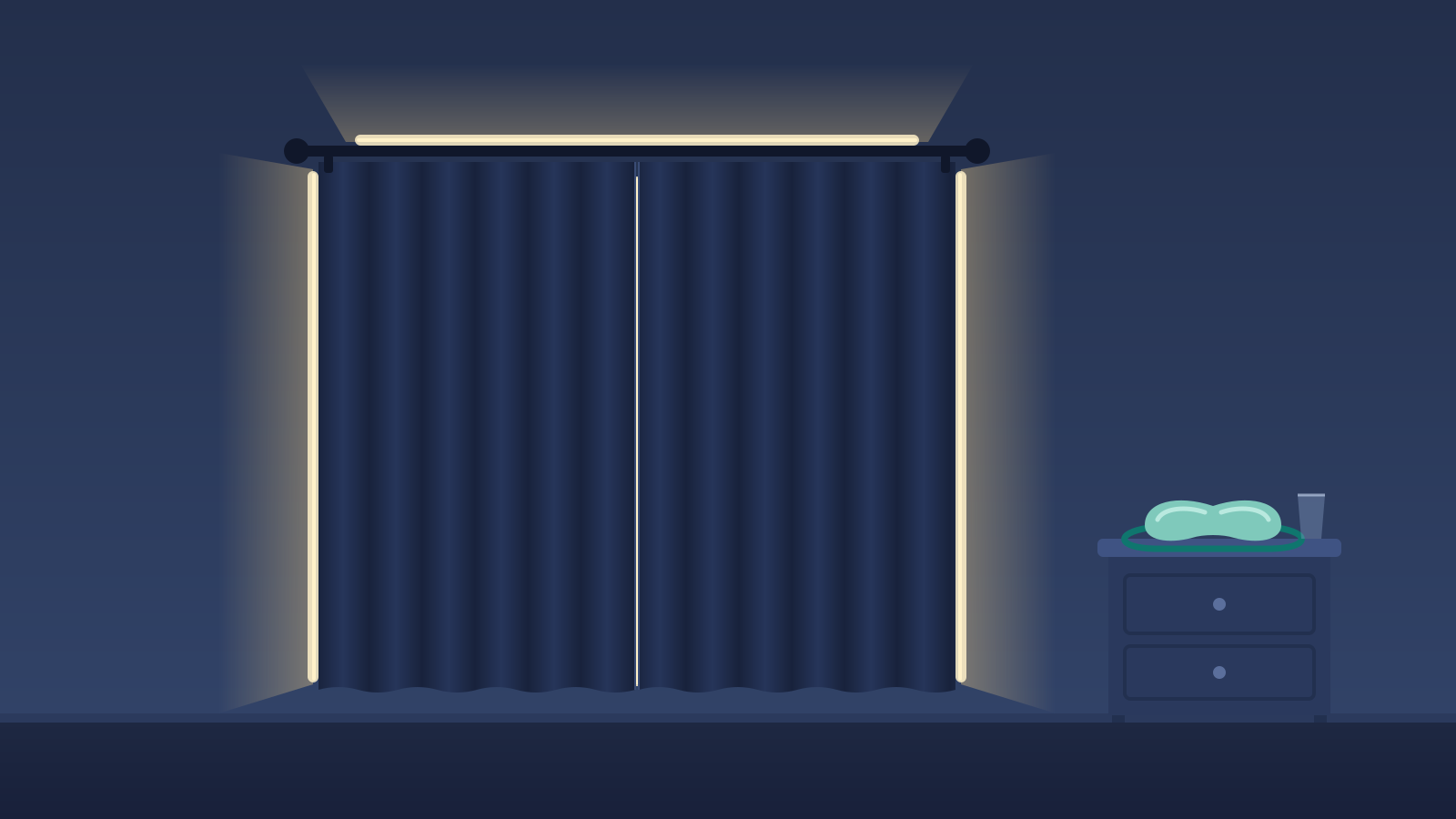
For most people, a contoured sleep mask is the better first fix: it's the smaller purchase, you can try it tonight, and it blocks light from every direction. Blackout curtains win first when the light comes through the window and you share the room, sleep during the day, or can't stand anything on your face.
The short version
For most people, a contoured sleep mask is the better first fix: it’s the smaller purchase, you can try it tonight, and it blocks light from every direction. Blackout curtains are the better first fix when the light comes through the window and you share the room, sleep during the day, or simply can’t stand anything on your face.
That’s the whole sleep mask vs blackout curtains question in two sentences. The rest of this guide helps you work out which side you’re on, with a check you can do tonight, a side-by-side table and picks for the situations that change the answer.
Where is the light coming from?
This one question decides most of it.
Light from inside the room follows you. A partner reading in bed, a phone lighting up, a TV standby light, a hallway left on for a kid or a pet. Curtains do nothing about any of it. A mask blocks all of it, because it works at your eyes, not at the window.
Light from outside the room comes through the window: a streetlight, a neighbor’s security light, a summer sunrise that arrives long before your alarm. A mask handles this too, as long as it stays on. Curtains handle it for everyone in the room, all night, whether you roll over or not.
So the mask covers both kinds of light for one person. Curtains cover one kind of light for the whole room. That’s why the mask is usually the cheaper, faster test, and why curtains become the better buy once the window is clearly the problem.
The decision rule
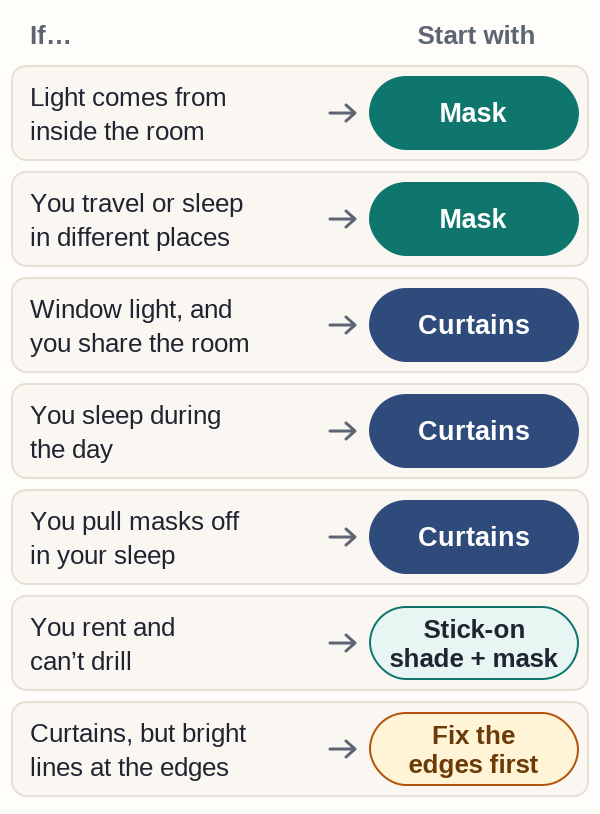
- If the light comes from inside the room, start with a mask.
- If you travel, or sleep in more than one place, start with a mask.
- If the window is the problem and you share the room, start with curtains. A mask only helps the person wearing it.
- If you sleep during the day (shift work, a newborn’s schedule), start with curtains. The National Heart, Lung, and Blood Institute suggests light-blocking curtains for daytime sleep (NHLBI).
- If you’ve tried masks and keep pulling them off in your sleep, go straight to curtains.
- If you rent and can’t drill, use a stick-on blackout shade on the window and a mask for whatever light is left.
- If you have curtains and still see a bright line at the edges, you don’t need a mask yet. Fix the edges first (see below).
A 5-minute check you can do tonight
Before you buy anything, find out what you’re actually fighting.
- At bedtime, turn off every light and lie down where your head normally goes.
- Wait a few minutes for your eyes to adjust.
- Hold one hand up at arm’s length. If you can clearly see your fingers, the room isn’t dark yet.
- Look for the source. Is it the window? A glowing charger, router or smoke-alarm LED? Light under the door?
- If early morning light wakes you, note the time and look at the window when it happens. Is the glow coming through the middle of the curtain, around the sides, over the top, or through the seam where two panels meet?
Small LED lights can often be fixed with a piece of tape or by turning a device to face the wall. If the answer to step 4 is mostly the window, curtains move up your list. If it’s mostly things inside the room, or a mix, a mask is the faster win.
Sleep mask vs blackout curtains, side by side
| Sleep mask | Blackout curtains | |
|---|---|---|
| Blocks light from inside the room | Yes | No |
| Blocks window light | Yes, while it stays on | Yes |
| Works if you toss and turn | Can slip off | Yes |
| Helps a partner | Only the wearer | The whole room |
| Morning light when you wake | Take it off, and the room is bright | Room stays dark until you open them |
| Setup | None | Rod, brackets, often drilling |
| Travel | Fits in a pocket | Stays home |
| Renters | Fine | Check your lease, or use a no-drill shade |
| Things on your face | Yes, which some people never get used to | No |
Does blocking light actually matter?
The broad advice is consistent. NHLBI tells adults to keep the bedroom “quiet, cool, and dark,” and notes that a dim night light is fine if you need one (NHLBI). The pattern of light and dark has the biggest influence on your body clock (NIGMS).
On masks specifically, the research is small but encouraging:
- In a 2023 study from Cardiff University, young adults (ages 18–35) slept for a week with a light-blocking eye mask and a week with a control that let light in (in most rounds, a mask with holes cut over the eyes). With the real mask, they did slightly better on a next-day word-pair memory task and had faster reaction times. Total sleep and how well they rated their sleep didn’t change (Greco et al., Sleep).
- A 2021 review of 13 trials found that eye masks, alone or with earplugs, improved self-reported sleep quality, but this was in intensive care units, a far brighter and noisier place than a bedroom (Fang et al.).
On light during sleep, a Northwestern lab study put 20 healthy young adults to sleep for one night with overhead lights on (about 100 lux) and compared them with sleep in a dim room. With the lights on, their heart rate during sleep was higher and their next-morning insulin resistance was higher (Mason et al., PNAS). That’s one night in a small group, under brighter light than most bedrooms get. It’s a reason to aim for a dark room, not a reason to worry about a streetlight.
Is it healthy to sleep with blackout curtains?
Sleeping in the dark is what public-health guidance recommends, so blackout curtains are in line with it (NHLBI). The trade-off comes in the morning. Light reaching your eyes is what keeps your internal clock in step with the day (Blume et al.), and a room that stays pitch black past your alarm takes that cue away. The easy fix: open the curtains when you get up, and get some daylight. NHLBI suggests spending time outside every day when you can.
What are the downsides of wearing a sleep mask?
- It can slip off, especially if you move a lot or sleep on your stomach.
- It can feel warm on a hot night.
- A flat mask presses on your eyelids. Contoured masks with cups avoid this by sitting around the eyes.
- It takes some getting used to. Give it several nights before you decide.
- Hygiene. It sits on your face every night, so it needs regular washing; follow the maker’s care instructions.
If a mask still bothers you after a week or two, that’s your answer: curtains are the better fix for you.
Why do blackout curtains still let light in?
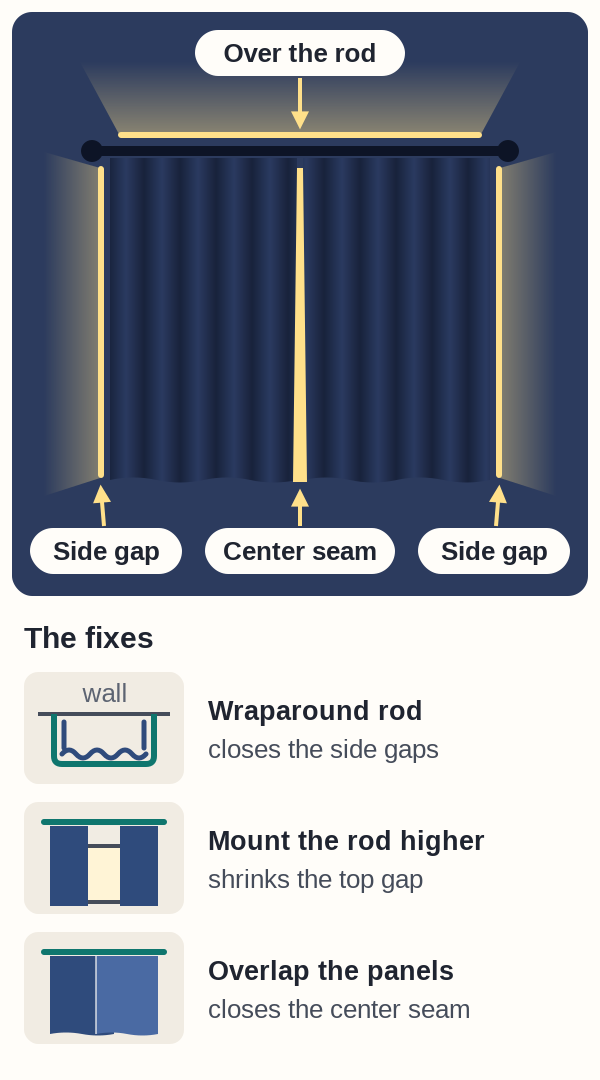
Usually it isn’t the fabric. It’s the gaps:
- The sides. A straight rod holds the curtain a few inches off the wall, and light pours around the edge. A wraparound rod curves back to the wall so the fabric sits flush.
- The top. Light comes over the rod. Mounting the rod higher above the window frame shrinks the gap.
- The middle. Two panels that just meet will part a little overnight. Use panels wide enough to overlap.
- The width. A rod and panels that extend past the window frame on both sides leave less room for light to sneak around.
Fix those before you add more layers. Our guide to light leaking around blackout curtains goes gap by gap, with makers’ measurements and fixes that need no drill.
What to look for if you buy
In a sleep mask:
- Shape. Contoured cups that sit around the eyes block more light and keep pressure off your lids. Flat masks are thinner but let more light in.
- An adjustable strap that holds without squeezing. Too tight and it presses; too loose and it’s gone by 3 a.m.
- Washability. Check whether it can go in the machine or needs hand washing, and whether you’ll actually do that.
- How you sleep. Side sleepers press one side of the mask into the pillow, so a slimmer profile matters more.
In blackout curtains:
- How the blackout is made. A built-in backing or lining does the work. Some brands sell “room darkening” and “blackout” as separate lines, so check which one you’re getting.
- Length and width. Long enough to reach past the sill, wide enough to overlap in the middle.
- How it hangs. Grommets, a rod pocket or back tabs each need a matching rod, and a wraparound rod needs a style it can take.
Can you use both?
Yes, and plenty of people end up there: curtains for the window, a mask for the phone or the partner’s lamp. If you start with a mask and still wake at sunrise, add curtains. If you start with curtains and still see a glow from inside the room, add a mask.
If your room runs warm too, a heat-trapping pillow can be the next thing keeping you up; see our guide to what to do when a memory foam pillow sleeps too hot.
How we researched this
This is a research comparison, not a hands-on test. We haven’t used these products ourselves. We chose picks by situation, checked each product’s current specs on the maker’s own website on November 17, 2026, and read the published studies and public-health guidance linked throughout. Where a claim is the maker’s (for example “100% blackout”), we say so. We list no prices because they change; check the seller’s page.
If you regularly have trouble falling or staying asleep even in a dark room, talk to your healthcare provider (CDC).
Our picks
Manta ORIGINAL Sleep Mask
contoured sleep mask with adjustable eye cups
- Best for
- Light from inside the room (a partner's lamp, a phone, a hallway), travel, and anyone who wants to test darkness before buying curtains
- Why it won
- The eye cups are separate pieces you slide along the strap, so they sit around your eyes instead of pressing on the lids. The maker claims it blocks 100% of light and puts zero pressure on the eyelids. It is machine washable (cold, in the included mesh bag) and comes with a 60-day money-back guarantee.
- Watch out
- Bulkier than a flat mask. The maker sells a separate PRO version for side-sleep comfort, which suggests the ORIGINAL isn't its slimmest option for side sleepers. Without the mesh bag, the maker warns, the foam cups can deform in the wash.
- What it beat
- Beat flat masks for full darkness, because its cups are shaped to sit around the eyes rather than lie on them; beat curtains as a first step because it works the same night and goes with you when you travel.
Slip Sleep Mask (pure silk)
flat silk sleep mask
- Best for
- People who only need to dim the room, find foam cups too bulky, or want the thinnest thing on their face
- Why it won
- Thin and light, made with the maker's own silk with a pure silk filler and liner, so there's little to press into the pillow.
- Watch out
- Hand wash only, in cold water, per the maker's care page. It's a flat mask, so it doesn't claim full blackout the way a cupped mask does. The maker's page doesn't list a silk weight (momme).
- What it beat
- Beat the contoured Manta for people who mostly want less bulk and only a dimmer room; lost the top spot because a flat mask blocks less light.
NICETOWN Nocturne 100% Blackout Curtains (2 panels)
full-blackout curtains with a built-in backing
- Best for
- Window light (streetlights, early sunrise), shared rooms, and day sleepers
- Why it won
- Heavyweight 260 GSM fabric with a built-in black backing, so there's no separate liner to buy or hang. The maker claims it blocks 100% of incoming sunlight. Machine washable cold on gentle. Comes in lengths from 63 to 108 inches.
- Watch out
- Hangs from a rod pocket, hidden back tabs or clip rings (sold separately), not grommets. The page lists no fiber content or certification. Like any curtain on a straight rod, light can still get in at the sides and top. Ready-made returns within 30 days of delivery.
- What it beat
- Beat curtains that need a separate clip-in liner to reach full blackout, and listings from the same brand whose blackout claims vary by model and color.
Umbra Twilight Blackout Curtain Rod
wraparound curtain rod
- Best for
- Curtains that already block light but leak a bright strip at the sides
- Why it won
- The rod curves back to the wall at both ends, so the curtain sits flush against the wall instead of leaving a side gap. Two length ranges (30–84 and 66–144 inches), holds up to 22 lb with the included center bracket, and works with grommet, back-tab, rod-pocket and tab-top curtains.
- Watch out
- Needs drilling. It fixes the sides, not the gap above the rod or the seam where two panels meet. Check that your curtain's rod pocket fits a 3/4-inch rod.
- What it beat
- Beat stick-on side strips and magnets, which have to hold fabric against the wall all night; the rod does it by shape.
Redi Shade Original Paper Blackout Shades
no-tools, trim-to-fit paper blackout shade
- Best for
- Renters and anyone who can't drill, or a quick fix while you decide on curtains
- Why it won
- You trim it at home and stick it inside or outside the window frame, with no drill, screws or brackets. Cordless; you raise it with the included clips. The maker says it blocks up to 99% of light.
- Watch out
- It's paper, sold as a 4-pack in 36- or 48-inch widths (72 inches long). Not 100% blackout by the maker's own claim. Larger windows need two shades overlapped.
- What it beat
- Beat clip-in blackout liners for renters, because a liner needs an existing rod and curtains to hang from; beat tape-up foil because it can be raised during the day.
Watch
- Blackout curtains still letting light in? The 3 gaps (YouTube Short, 0:34)
Sources
- Healthy Sleep Habits, National Heart, Lung, and Blood Institute (NIH)
- Circadian Rhythms (fact sheet), National Institute of General Medical Sciences (NIH)
- Wearing an eye mask during overnight sleep improves episodic learning and alertness (Greco et al., Sleep, 2023), Sleep (Oxford Academic), via PubMed Central
- Effect of earplugs and eye masks on the sleep quality of intensive care unit patients: a systematic review and meta-analysis (Fang et al., 2021), Journal of Advanced Nursing
- Light exposure during sleep impairs cardiometabolic function (Mason et al., 2022), PNAS, via PubMed Central
- Effects of light on human circadian rhythms, sleep and mood (Blume et al., 2019), Somnologie, via PubMed Central
- About Sleep, Centers for Disease Control and Prevention